

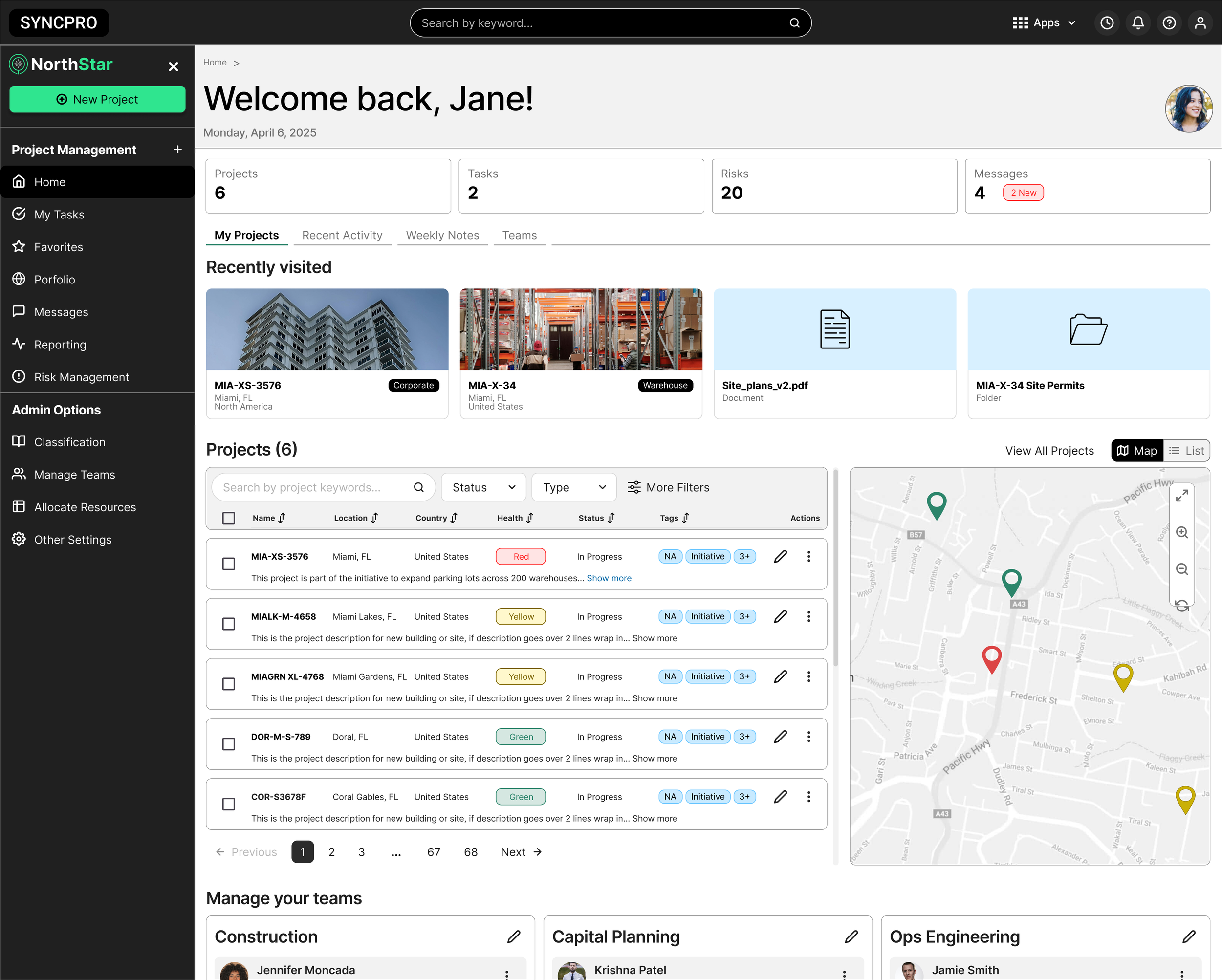
Unifying program management for distributed teams
A 0→1 enterprise platform designed to replace fragmented workflows with a more scalable system for tracking work, sharing updates, and communicating project health.
Role: Product Designer
Timeline: 2024-2026
Platform: Web App
🔒For NDA confidentiality purposes
Original product imagery has been omitted.
This case study uses generalized language, and mock data to protect proprietary information while preserving the design process and outcomes.
My Role
As the product designer on a 0→1 enterprise program management platform, I led the design process from discovery through launch, helping shape a unified system for managing projects, updates, and reporting across multiple personas.
✅ I conducted research
✅ Co-led workshops with product managers
✅ Mapped user journeys & workflows
✅ Created wireframes
✅ Validated concepts with users
✅ Partnered with product/engineering tech teams
✅ Helped shape the MVP scope under evolving priorities
UX RESEARCH
KPI METRICS
USABILITY TESTING
USER JOURNEY
The Result
A more scalable platform that improved reporting consistency, increased visibility into project health, and helped drive CSAT from 3.5/5 to 4.38/5 within one quarter, while adoption grew from 1,000 to 4,000 users within two quarters.
0→1
MVP Launched
in 12 months
4.38/5
Avg. Customer Satisfaction
Score within the first year.
1k → 4K
Monthly Active Users
Within two quarters post launch
The Challenge
Teams across regions had no shared system for managing projects, tracking progress, or reporting status to leadership. Over time, everyone built their own process — and it showed.
The result was a fragmented environment where the same update lived in three different places, no two teams spoke the same language, and leadership had no reliable way to see what was actually happening across the organization.
The challenge wasn't just to build a better tool. It was to design a system that multiple personas could actually adopt — one that reduced the operational overhead without requiring everyone to change how they worked overnight.
Pain Points
Manual repetitive updates
Teams copied the same status across multiple tools with no single source of truth, creating unnecessary rework every cycle.
Terminology mismatches
Different teams used different language for the same work, making unified reporting to leadership inconsistent and unreliable
No dependency visibility
When one team's work unblocked another, there was no way to know. People found out by asking around or missing deadlines.
Disconnected tools
The average user toggled between several platforms to complete one workflow, creating friction and scattered, inconsistent data.
Framing user needs through
Jobs to Be Done (JTBD)
To better understand what users were ultimately trying to accomplish, I mapped their needs through a Jobs to Be Done framework. This helped shift the focus away from features and toward the real outcomes users needed to achieve across planning, coordination, and execution.
What is JTBD?
Jobs to Be Done (JTBD)is a framework for understanding what people are really trying to accomplish, independent of any specific tool or feature. Instead of focusing on the product itself, it helps define the underlying outcome a user needs to achieve and what success looks like from their perspective.
Persona
The primary user group of the app.
Visualizing The User Journey
Identifying where to focus on
Information Architecture
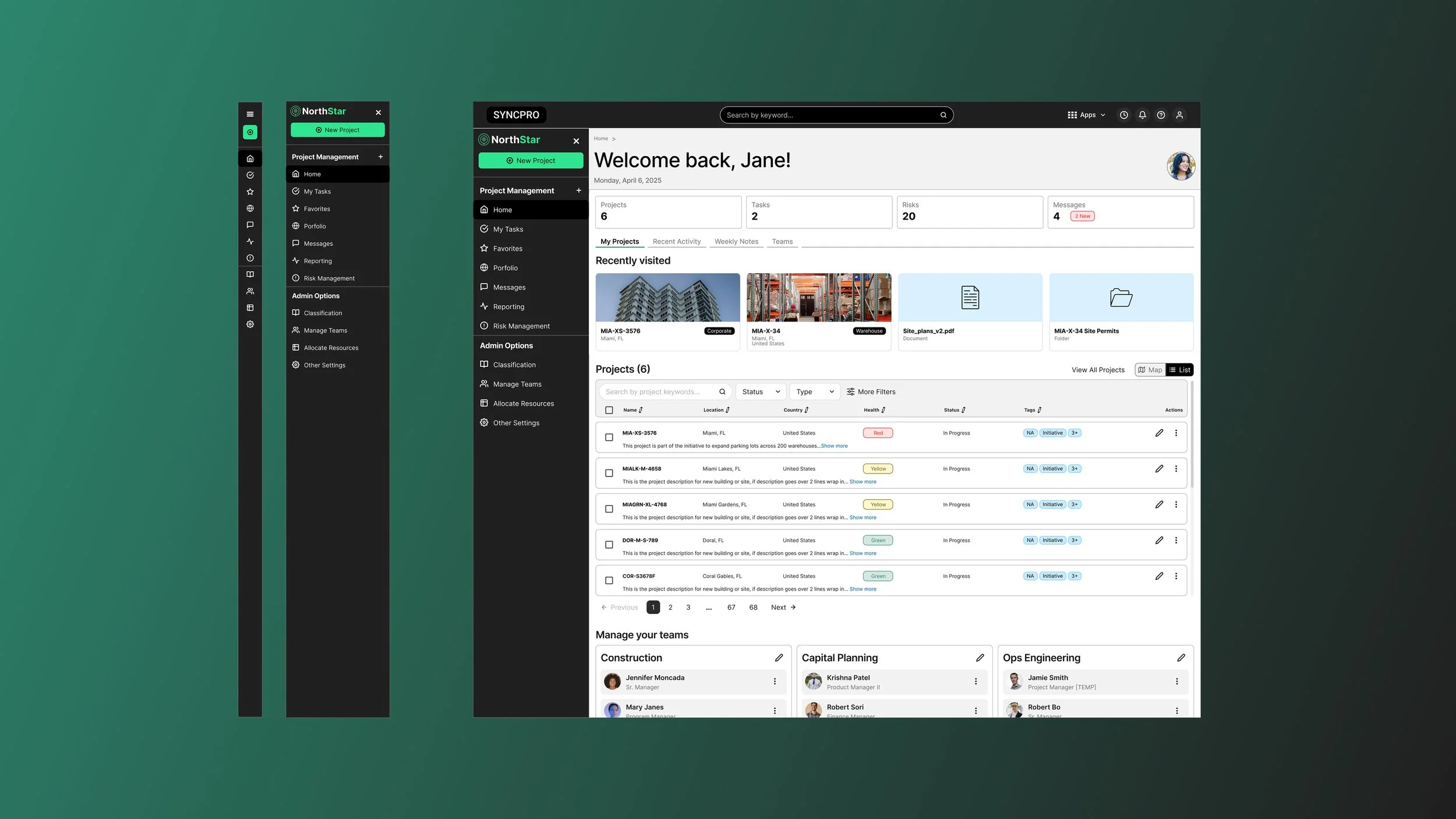
Navigation + Site Map
When designing Northstar's navigation, the core challenge wasn't just organizing pages — it was designing a system that three very different personas could adopt without training, while still supporting the complexity of enterprise program management.
The guiding principle was simple: every page must earn its place.
Using a Jobs To Be Done framework, I mapped every page in the system to a specific user outcome before a single wireframe was drawn. If a page couldn't answer "what is the user trying to accomplish here?" it didn't ship.
The House Analogy
To communicate the IA structure across the team, I used a house analogy — where pages are rooms, actions are functions, and components are furniture. Every room exists for a purpose.
This framework helped us:
Stay aligned on why each page existed during MVP definition
Prevent scope creep by questioning every new page against its purpose
Translate complex UX concepts to non-design audiences like leadership and engineering — ensuring buy-in at every stage
Navigation Depth Goal
Research shows that users abandon navigation after more than 3-4 clicks to find information.
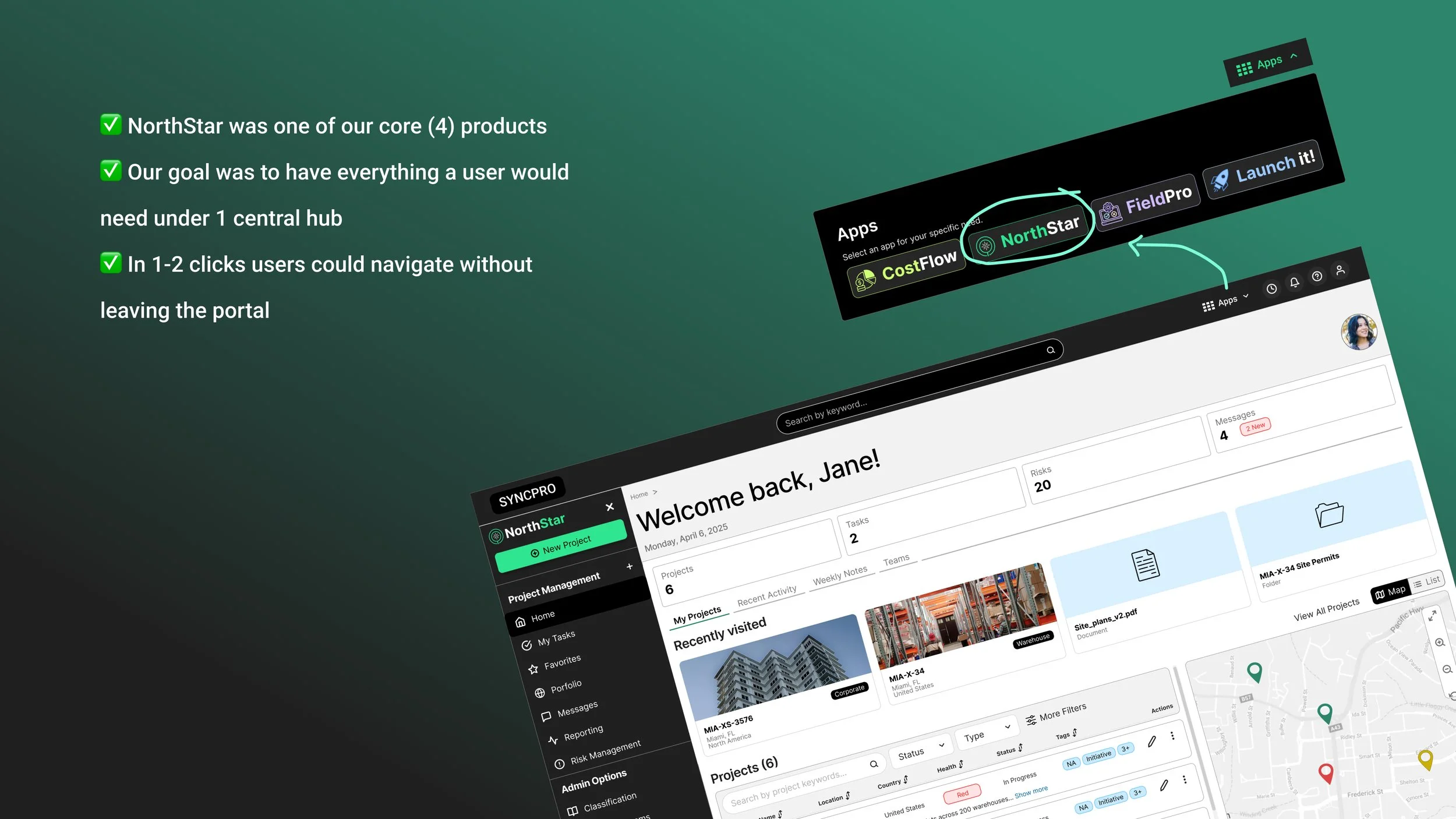
I designed Northstar's navigation to keep every critical workflow within 1-3 clicks from the home page — meaning any user could find a project, a timeline, or a task list without ever feeling lost.
Permission-Based Navigation
I designed each persona's navigation intentionally around their Jobs To Be Done — only surfacing the pages and actions relevant to their specific outcomes. If a page didn't serve their JTBD, it didn't appear in their view.
Central PMs/Admins — configure, manage and scale the platform across teams
Project Managers — execute, track and coordinate day-to-day work
Leaders/Viewers — monitor portfolio health and communicate status upward without operational noise
One platform. One design system. Three intentionally different experiences shaped entirely by what each user needed to get done.
The opportunity was to create a unified system that improved visibility, reduced friction, and still supported the needs of different users.
Opportunities
Unify fragmented workflows
How might we bring disconnected project workflows into one scalable platform?
Improve project health visibility
How might we make progress, risk, and momentum easier to understand?
Support multiple personas
How might we balance administrative oversight with day-to-day execution in the same system?
Define the right MVP
How might we focus phase one on the highest-value workflows first?

Shaping the MVP
My Approach
Discovery & Research
Led interviews, workshops, and contextual inquiry to understand fragmented workflows, user needs, and operational pain points.
This enabled: a clearer understanding of where the biggest gaps and opportunities existed.
Workflow Mapping & MVP Definition
Mapped the end-to-end journey across personas and helped define the highest-value workflows for phase one.
This enabled: a more focused MVP grounded in real user and business needs.
Concepting & Validation
Created wireframes and prototypes, then validated and refined them with users, product, and engineering.
This enabled: faster alignment and stronger confidence in the solution before launch.
Impact & Iteration
Used feedback and post-launch insights to improve usability, strengthen adoption, and raise CSAT over time.
This enabled: a better product experience that improved satisfaction and scaled more effectively.
Results and Impact
✅ More Consistent Project Workflows
Bringing fragmented tools into one platform created a more structured way for teams to manage projects, share updates, and maintain momentum across workflows.
✅ Stronger Adoption and Onboarding
A more intuitive and scalable experience helped improve onboarding completion by 30% and supported growth from 1,000 to 4,000 users within two quarters.
✅ Clearer Reporting and Project Visibility
Standardized reporting and dashboard patterns made it easier for administrators and leaders to understand progress, risks, and project health with confidence.
✅ Improved Satisfaction Through Iteration
Post-launch feedback loops helped uncover usability gaps early, contributing to a CSAT increase from 3.5/5 to 4.38/5 within one quarter.
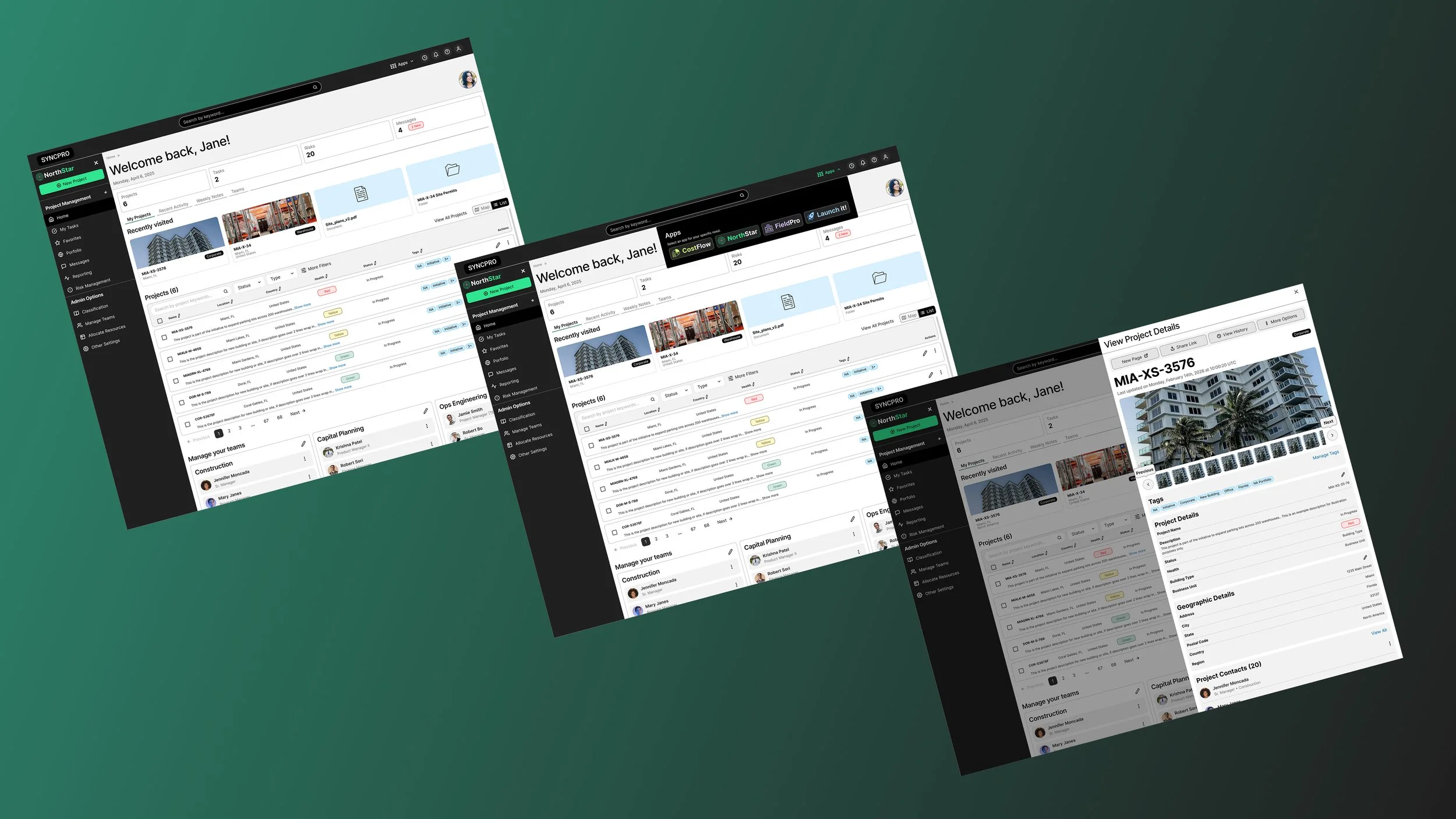
We built.
We Measured.
We Learned.
Reflection
Designing Northstar reinforced how complex enterprise products are rarely just about interface design. The real challenge was aligning multiple personas, evolving product direction, and business priorities into one system that could launch realistically and still create long-term value.
This project strengthened my ability to navigate ambiguity, define MVP under pressure, and use research and feedback to guide decisions from discovery through iteration. It also reinforced that some of the most meaningful product improvements happen after launch, when real usage reveals where the experience needs to evolve.